 Supper Table Reading
Two Teaspoons in Water With Supper: An Amber Bottle's Directions, Word by Word
Nature's Answer sells its liquid CoQ10 in an eight-ounce amber glass bottle from Long Island, and its label asks for one small ritual at the table each day. I checked every part of it against what's actually known.

This is a paid advertisement. Sponsored by Nature's Answer, Inc.

Before supper, a plain note: the byline on this page is a house name.
Elm Street, its suppers and the neighbors in this story are composites drawn from ordinary evenings, and none of them is a customer or a result.
What this page says about the bottle comes from the seller's listing, its ingredient panel, its return terms and the published research, all read in September 2026.
Where a number appears, you'll find where it came from.
On our street, supper is at six.
It has been at six for as long as I can remember, in my house and in most of the houses on the block.
You can tell the time by the kitchen lights.
They come on one after another, like somebody walking down the street with a match.
And after supper, if the weather's decent, half the street goes for a walk.
Nobody plans it, but you'll pass the same faces at the same corner most nights.

You probably have a street like mine.
Maybe it's a cul-de-sac, a county road or the hallway of a building where everybody knows whose dog that is.
And you probably know the feeling I'm going to describe, because it sneaks up on nearly everybody past sixty.
The walk to the corner is the same walk it always was, but some evenings it feels a little longer than you remember.
It isn't alarming.
It's just there, the way your reading glasses are just there now, on the table, where they didn't used to be.
Nothing's wrong. The corner just seems farther away than it did.
That's the evening my neighbor Norm came across the street with a brown glass bottle in his hand.
His wife June had ordered it, and he'd been told to start taking it with supper.
"You read labels," he said, and set it on my porch railing.
"Tell me what this is and how I'm supposed to drink it."
I turned the bottle around, put my glasses on and found the directions.
They were one line long.
"Take two (2) teaspoons (10 mL) with 8-10 oz of water once per day, preferably with a meal."
That's the whole instruction, and at first glance there's nothing to it.
But I've learned that the shortest line on a label is usually the one somebody thought hardest about.
So Norm and I made a deal on the porch that night.
I would read that one line word by word, and for every word I'd find out why it's there.
This page is what I found.
It isn't medical advice, and it isn't a verdict on whether you should buy anything.
It's a neighbor's reading of one sentence on one bottle.
By the end, you'll know what each part of it is doing and what it isn't.
Six O'Clock on Elm Street
Let me tell you a little more about the street, because the street is where this whole question lives.
Elm Street has thirty-one houses, a mailbox on every post and more old elm trees than the town can afford to trim.
Most of us have been here a long time.
We raised kids here, buried dogs in the backyards and argued about the same storm drain for thirty years.
So when something new shows up on somebody's supper table, the whole block hears about it.
A new casserole dish, a new grandchild's photo, a new bottle beside the salt shaker.

Here's what I've noticed about the bottles that appear on the tables around here.
They almost always arrive because somebody worried a little, read something, and bought something.
The worry is ordinary.
It's the walk that feels longer, the stairs to the attic that you take one at a time now, the afternoon when you'd rather sit than rake.
Then comes the reading.
And if you've looked at the shelf of products sold for the heart and circulation, you know how loud it is.
Bottles promise things in capital letters.
Advertisements tell you that something happens "after 60," as if a birthday flips a switch.
So what's the usual answer?
For most of us, it's to buy what somebody else bought, take it the way we think we're supposed to, and hope.
And why isn't that enough?
Because a product only does what it can do, and it only does that if you take it the way it was designed to be taken.
That second part is where Norm's question comes in.
If there's a reason for every word in the directions, then taking it "roughly like the label says" might be taking something else entirely.
I've watched how people on this street take the things they buy.
I've done it myself, so I'm not pointing fingers.
The bottle goes on the counter by the coffee maker.
In the morning, before breakfast, somebody pours a guess into a spoon from the silverware drawer, swallows it standing at the sink and chases it with coffee.
It feels like taking it.
But if the label asked for a measured amount, in a glass of water, with a meal, then almost every part of that morning ritual is a little off.
Does that really matter?
For some products, maybe not much.
For this one, as you'll see, it matters a lot, because of what CoQ10 is and how the body takes it in.
The spoon, the water and the meal aren't decoration on the label; they're the delivery plan.
And here's the other thing about the usual answer.
When a bottle doesn't seem to do anything, most people don't go back and read the directions.
They decide the product "didn't work," put it in the back of the cupboard and buy the next one the advertisements talk about.
The cupboard over June's refrigerator has a whole shelf of those, and she'd be the first to tell you.
The directions are part of the product. They're just the part nobody reads.
So before we get to the bottle, the maker or the price, let's take that sentence apart.
There are five pieces in it, and each one has a reason.
- "Two teaspoons (10 mL)": how much, and with what spoon.
- "With 8-10 oz of water": why water, and why that much.
- "Once per day": why not twice.
- "Preferably with a meal": why the meal matters more than you'd think.
- And the one word the label doesn't print at all: CoQ10, and what it actually is.
We'll start with that last one.
You can't make sense of the directions until you know what they're directing.

First, a Word the Directions Assume You Know
What is CoQ10?
Its full name is coenzyme Q10, and it's a substance your body already makes on its own, in almost every cell.
It's fat-soluble, which means it dissolves in fat rather than in water.
Your body makes it and also takes some in from food, which is why it isn't counted as a vitamin. [1]
So it's not a vitamin?
No, and that's worth a second of your time, because it changes how you think about it.
A vitamin is something your body needs from food because it can't make it.
CoQ10 is something your body makes for itself, and food only adds a little on top. [1]
That's why nobody's grandmother told them to eat their CoQ10.
It was never on the list, because the body keeps its own supply running.
What does it do in the body?
It works inside the mitochondria, the tiny power plants in your cells.
There, it's a crucial part of the process that turns the energy in carbohydrates and fats into ATP. [2]
ATP is the fuel that runs the cell's machinery, from a muscle fiber in your calf to the cells of your heart.
It also sits in other membranes of the cell.
In its ubiquinol form, it acts as an antioxidant, directly or by helping regenerate vitamins E and C. [2]

Where is there the most of it?
In a federal summary from the National Institutes of Health, the heart is named among the organs with the highest levels. [3]
A study of human tissue samples found the heart among the three tissues with the most CoQ10, around 60 to 110 micrograms per gram. [4]
That makes sense for an organ that never takes a day off.
The same study found that in most tissues, 70 to 100 percent of it was in a form called ubiquinol. [4]
Keep that word in your pocket, because it comes back later.
Does the body make less of it as we age?
Here's where you have to read carefully, because this is the sentence advertisements love to stretch.
The Linus Pauling Institute at Oregon State University says that its concentration in a number of tissues falls gradually with age. [1]
And in the same breath it says it's unclear whether that fall amounts to a shortage, and that a shortage hasn't been described in the general population. [1]
So the honest version is "a little less, gradually," not "your body has run out."
I read that sentence to Norm twice.
He said it sounded like his hair: thinner than it was, still there, and nobody's measuring.
Why does this matter for the directions?
Because if the body is still making its own, the question isn't "how do I replace it," it's "does adding some change anything."
We'll get to that question honestly.
But first, let's see how much of it you're already getting at six o'clock every night.
What a Plate on Elm Street Already Holds
Does food have CoQ10 in it?
Yes, and the richest sources are the ones on most American supper plates.
Meat, fish, nuts and some cooking oils carry the most. [5]
Dairy, vegetables, fruits and cereals carry much less. [5]
The Linus Pauling Institute puts the average diet at about 3 to 6 mg a day, mostly from meat, poultry and fish. [6]
A national survey in Denmark came out at 3 to 5 mg a day, with about two thirds of it from meat and poultry. [7]
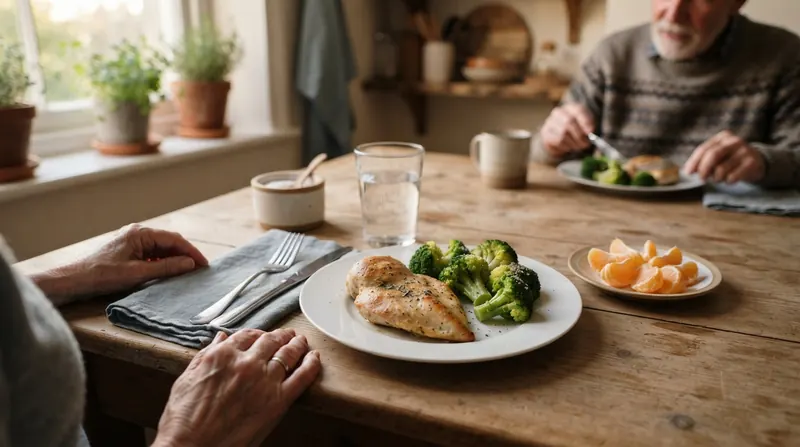
The institute also publishes a table of what common foods hold.
I took it to the kitchen and built an ordinary Tuesday supper out of it.
- Three ounces of fried chicken: about 1.4 mg. [6]
- Half a cup of boiled broccoli: about 0.5 mg. [6]
- A tablespoon of canola oil in the pan: about 1.0 mg. [6]
- A medium orange for dessert: about 0.3 mg. [6]
Add it up and that plate carries about 3.2 mg.
Swap the chicken for three ounces of marinated herring and you'd add a little, since the table lists it at 2.3 mg. [6]
What about the rest of the day?
Breakfast barely registers: a boiled egg holds about 0.1 mg. [6]
An ounce of roasted peanuts on the porch adds about 0.8 mg, and three ounces of steamed rainbow trout on a Friday adds about 0.9 mg. [6]
A tablespoon of soybean oil holds about 1.3 mg, a little more than the canola. [6]
So a whole ordinary day, on an ordinary American plate, lands right around that 3 to 6 mg figure.
I checked my own week against the table, and I never once got close to 10.
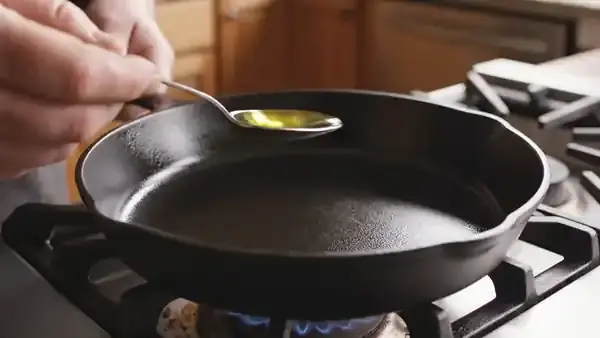
Does cooking change it?
It does, and the Danish researchers measured how.
Frying destroyed 14 to 32 percent of the CoQ10 in the food. [7]
Boiling caused no loss they could detect. [7]
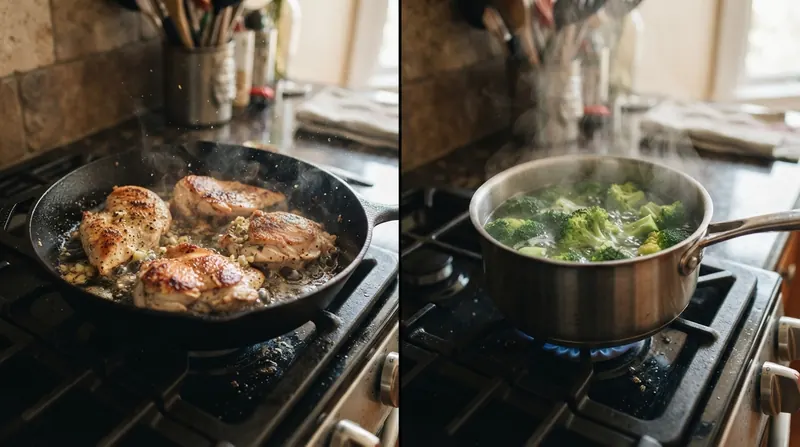
Now, I'm not going to tell you to stop frying chicken.
My late wife's fried chicken is one of the reasons I still live on this street.
But it's worth knowing that the same food can carry different amounts depending on the pan.
And it's worth knowing that none of these numbers is large.
So how does two teaspoons compare?
The bottle on Norm's porch railing says 100 mg of CoQ10 per two teaspoons.
That's about as much as thirty of my Tuesday suppers, on paper.
And supplements for adults usually provide somewhere between 30 and 100 mg a day, so this one sits at the top of the usual range. [6]
Thirty suppers, on paper. The words "on paper" matter.
Here's why I keep saying that.
The amount on a label and the amount that reaches your blood are two very different numbers.
The Linus Pauling Institute says less than 5 percent of a dose taken by mouth is thought to reach the circulation. [8]
It also estimates that food provides about a quarter of the CoQ10 in your blood. [8]
In other words, your plate is already doing part of the work, and the bottle's big number shrinks a lot on its way in.
That's the problem the rest of the directions are trying to solve.
"Two Teaspoons (10 mL)"
Let's start where the label starts.
Two teaspoons, which the label also writes as 10 mL.
Those two measurements are telling you something.
They're telling you which spoon to use.
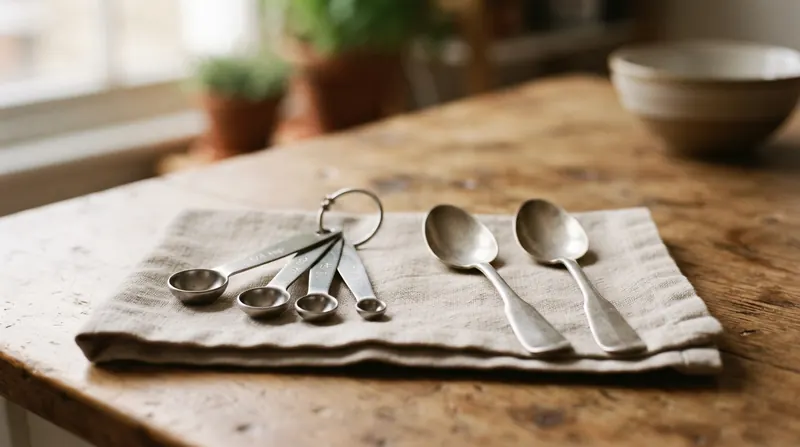
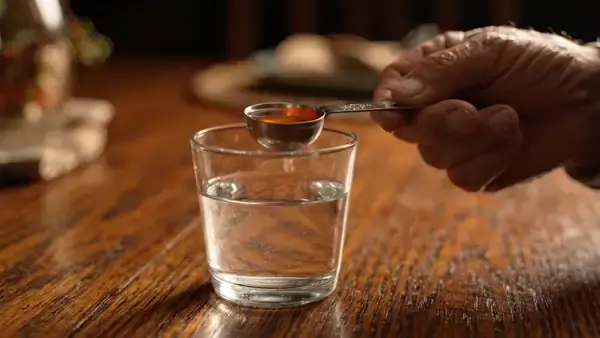
A measuring teaspoon holds about 5 mL, so two of them make the 10 mL the label prints.
The spoon from your silverware drawer is a different animal.
Dinner teaspoons come in all sizes, and some hold noticeably less than a measuring spoon.
If you use one of those, your "100 mg" quietly becomes something else.
So which spoon should you use?
The label's own number answers that: 10 mL is two level measuring teaspoons.
Norm found a set of measuring spoons in a drawer June uses for baking.
He keeps the teaspoon on the ring and hangs it on the same hook as the potholder now.
How long does a bottle last at that amount?
The bottle holds 8 fluid ounces, 240 mL, and the panel lists 24 servings.
That's 24 days at the label's amount.
It's a little short of a month, which is worth knowing before you mark your calendar for a reorder.
And what's in those two teaspoons?
The panel lists 100 mg of CoQ10 as ubiquinone, plus 495 mg of a lecithin blend from sunflower, 5 calories and 1 gram of fat.
Would four teaspoons be twice as good?
Norm asked that with a grin, and the answer is no, for two reasons.
The first is simple: the label says two, and the label is the only instruction this bottle comes with.
The second is how the body handles bigger amounts.
Blood CoQ10 does rise gradually with larger doses, but the share that's absorbed falls as the dose grows. [9]
So doubling the spoon doesn't double what arrives, and it doubles what you pay.
Should the teaspoon be level or heaped?
It's a liquid, so level is the only way it comes: fill the measuring spoon to the brim, and that's one.
We'll go through every line of that panel a little later.
For now, the point is simply this: the spoon is part of the dose.
The Bottle on the Porch Railing
All right.
We've read one word of the directions, and it's time to look at the bottle itself.
First, though, a word about why June picked this one, because it's the same reason a lot of people land on a liquid.
Norm doesn't like swallowing capsules, and he never has.
He'll tell you it's the size, and June will tell you it's the principle.
Either way, the shelf of big softgels was never going to work in their house.
So why a liquid in a glass?
Because a glass of water at supper is something Norm was already doing every single night.
June's thinking was simple: if the new thing hitches a ride on an old habit, it's more likely to stick.
I've read a lot of labels, and I don't think I've heard a better reason for choosing a format.
She also liked that it came in glass, and that the company had been around longer than their marriage.
The listing itself points to the glass, saying there's no plastic to leach into the liquid.
Those are her reasons, not evidence, and she'd say so herself.
But they're honest reasons, and they're the kind that decide what actually gets used in a kitchen.
It's an amber glass bottle, eight ounces, with a black screw cap.
It looks like something from the shelf of an old general store, which I suspect is the idea.
The logo on the label is a broad, round tree on a green band.
On a street named for trees, Norm took that as a friendly sign, and I didn't argue.
Who makes it?
Nature's Answer, Inc., a company in Hauppauge, New York, out on Long Island.
The label says "Since 1972," and the company has been making liquid supplements there for a long time.
They publish a street address, a toll-free phone number and a customer service email, which is more than a lot of bottles on that shelf can say.
What does the maker say it's for?
The listing talks about supporting healthy heart function with "the cellular energy" of CoQ10, with the asterisk that supplement labels carry.
That's the careful language labels are allowed to use, and it stays in the lane of normal function.
You'll notice I'm staying in the same lane, and so should any page that talks about this bottle.
Is there anything on the listing I'd push back on?
Yes, two things, and I'd rather you hear them from me than find them yourself.
First, the listing's headline calls the bottle a premium herbal extract.
That's a phrase the maker uses across its liquid products, and here it's simply inaccurate, because CoQ10 isn't an herb.
Second, the listing says the liquid is "enhanced with Quik-Sorb," a blend of ginger rhizome, amla fruit and capsicum "to support absorption."
The panel doesn't say how much of each is in there, and the listing doesn't cite a study of the blend, and I couldn't find one.
So when I talk about absorption on this page, I'm talking about the CoQ10, the water and the meal, not the blend.
Neither of those is a reason to walk away.
But you should know the difference between what's measured on this bottle and what's just written on it.
Now back to the directions.
Next word: water.
"With 8-10 Oz of Water"
Why water at all, if CoQ10 dissolves in fat?
That was Norm's first real question, and it's a good one.
CoQ10 dissolves in fat and not in water. [5]
Pour pure CoQ10 into a glass of water and it would sit there like oil in a puddle.
So a liquid that's meant to be stirred into water has to be built for it.
Look at the panel and you'll find the ingredients that do that job.
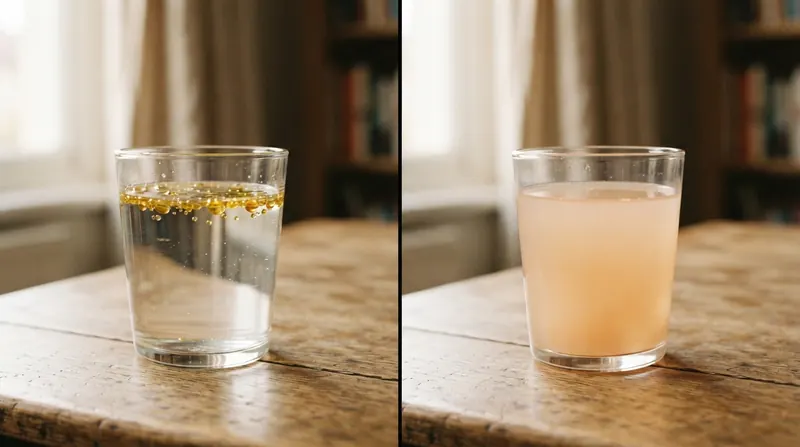
The first is a lecithin blend from sunflower, 495 mg per serving.
Lecithin is a mixture of the fats that cell membranes are made of, and in food it's an emulsifier, the ingredient that keeps oil and water mixed.
The second is a mouthful of a name: polyglycerol esters of fatty acids.
US food rules allow it as an emulsifier, and here it helps keep the oily CoQ10 evenly spread through the water.
The third is xanthan gum, a common thickener that helps keep a liquid from separating on the shelf.
Put together, they're the reason the water in Norm's glass turns an even pale orange instead of growing an oil slick.
Does mixing it into water actually help?
Here's what I can tell you, and where I have to stop.
Because CoQ10 doesn't dissolve in water, makers have developed forms that are better at dispersing in it, and those forms show improved absorption compared with standard powder. [5]
A review by two authors who worked for a CoQ10 company also found that solubilized forms produce larger rises in blood levels. [9]
The most interesting study for our street was done in people our age.
Twenty-one healthy adults aged 65 to 74 each took a single 100 mg dose with a light breakfast, in different forms, on different days. [10]
A water-soluble CoQ10 syrup delivered 2.4 times as much CoQ10 to the blood over 48 hours as standard capsules. [10]
Capsules of ubiquinol, the other form, weren't significantly different from the standard ones. [10]
Same dose, same people, same breakfast. The form made the difference.
Now for the part I promised Norm I wouldn't skip.
That syrup was a different product, made by a company that helped fund the study, and it was a single dose.
Nobody has run that study on this bottle.
So the honest sentence is: water-dispersible forms have done better than plain capsules in studies of other products, and this liquid is built on the same idea.
It isn't "this liquid is absorbed 2.4 times better."
Anyone who tells you that is borrowing a number from somebody else's bottle.
Why 8 to 10 ounces, and not a splash?
The label doesn't explain, but a full glass does two practical things.
It spreads two teaspoons of tangerine flavor into something you'd actually drink with supper.
And it makes the glass part of the meal, instead of a spoonful you gulp at the sink and forget about.
The listing also says it can be swallowed as it is or added to juice or smoothies.
That's fine, but the label's first choice is a glass of water, and I'll take the label's first choice.
Norm uses a plain tumbler that holds about nine ounces when it's filled to a finger below the rim.
He says it's the only glass in the house that nobody else uses, which is why it's his.
"Preferably With a Meal"
This is the word I'd underline twice if it were my bottle.
Preferably with a meal.
Why does the meal matter so much?
Because CoQ10 is fat-soluble, and fat-soluble things ride in with fat.
The Linus Pauling Institute says it plainly: CoQ10 is best absorbed with fat in a meal. [8]
That's the whole reason the word "meal" is on the label.
Look at what the bottle itself brings to the table: 1 gram of fat per serving.
That's not much, and it's not supposed to be the main source.
The fat that matters is on your plate.
A little butter on the green beans, olive oil on the salad, the skin on the chicken, a piece of fish.
What happens after you drink it?
Here the story gets slow, and slow turns out to be the point.
A review written by two employees of a CoQ10 maker traced the trip.
CoQ10 goes from the stomach into the small intestine, where bile helps package it with other fat-soluble nutrients, and then through the lymph into the blood. [11]
That trip usually takes 5 to 8 hours. [11]
Blood levels typically peak about six hours after a dose. [11]
So if Norm drinks his glass at six o'clock, the peak arrives around midnight, long after the dishes are dried and the porch light is off.
You won't feel a moment when it "kicks in," and you shouldn't expect to.

The same review adds something every buyer should hear.
How well any given formulation is absorbed varies widely from one person to another. [11]
That means two neighbors taking the same glass with the same supper can end up with different amounts in their blood.
It's not a flaw in the bottle, it's a fact about people.
"Once Per Day"
Why once a day, and not two smaller doses?
Because of the amount, and because of how long CoQ10 stays around.
The Linus Pauling Institute notes that doses above 100 mg a day are usually split into two or three. [8]
This bottle sits right at 100 mg, so one serving a day is the ordinary way to take that amount.
The other reason is time.
Once it's in the blood, CoQ10 takes about 33 hours to fall by half. [11]
That's a long, slow curve rather than a spike.
So a daily glass builds on the one before, and a steady level takes one to two weeks of daily use to build. [11]
One to two weeks just to reach a steady level. That's the first calendar fact to write down.
Does taking it make the body stop making its own?
Norm asked that one on his second evening, and it's a fair worry.
A review by employees of a large CoQ10 producer concluded that supplemental CoQ10 doesn't cut the body's own production. [12]
It also found that CoQ10 doesn't build up in blood or tissues after it's stopped. [12]
So if you stop, your body carries on doing what it was doing before.
And if you miss a supper, you haven't undone anything; you just take the next glass the next evening.
What about ubiquinol, that word from earlier?
This bottle uses ubiquinone, the standard form, and that's fine.
About 95 percent of the CoQ10 circulating in blood is already ubiquinol, and taking CoQ10 doesn't change that ratio. [9]
In the study of 65- to 74-year-olds, whatever form people swallowed showed up in their blood mostly as ubiquinol. [10]
In plain terms, your body converts it on its own.
You don't need to pay extra for a word on the front of a bottle.
What the Trials in Men Our Age Actually Measured
Now we get to the question underneath all the others.
If the glass raises the amount of CoQ10 in your blood, do you notice anything?
This is where I have to slow down, because it's where most pages speed up.
Raising a blood level and changing how your evening walk feels are two different claims.
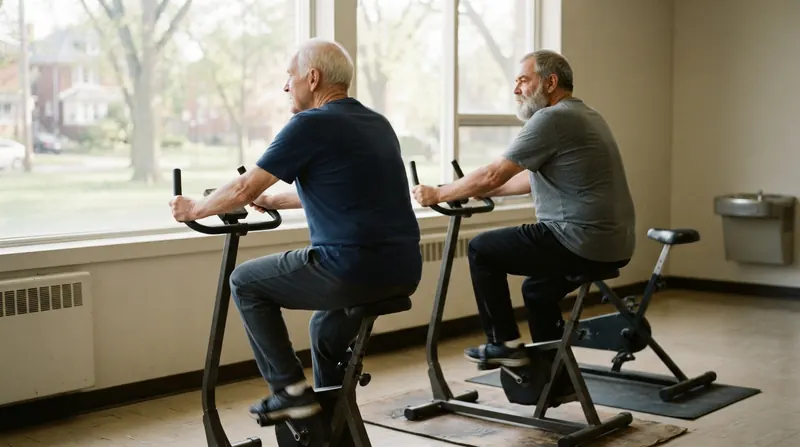
There's one trial I want you to know about above all the others, because it was done in men like us.
It's small, it's old, and it's honest.
In one trial, researchers gave trained men 120 mg of CoQ10 a day for six weeks, and a placebo for six weeks, in a crossover design. [13]
There were 11 younger men, aged 22 to 38, and 8 older men, aged 60 to 74. [13]
What happened to the CoQ10 in their blood?
It went up, in both the younger and the older men. [13]
And their stamina?
Their maximal oxygen uptake didn't improve. [13]
And in a long cycling test, time to exhaustion was actually slightly longer after the placebo. [13]
I read that line twice, and then I read it to Norm.
More CoQ10 in the blood. Not a longer ride.

Was that just one small study?
Yes, but it isn't alone.
A second small trial looked at 15 untrained men in their mid-forties, who took 150 mg of CoQ10 a day for two months. [14]
Their blood CoQ10 went up, and so did their own rating of their vigor on a simple scale. [14]
But their maximal oxygen uptake, their lactate threshold on a stationary bike and the blood flow in their forearm didn't change. [14]
So the men felt a little livelier on paper, and the bike and the stopwatch didn't notice.
The Linus Pauling Institute looked at the athletic trials as a group.
Most trials that compared 100 to 150 mg a day with a placebo for three to eight weeks, in trained and untrained men, found no difference in maximal oxygen use or time to exhaustion. [15]
One trial found a 4 percent higher maximal cycling workload. [15]
Two found greater improvement with the placebo than with CoQ10. [15]
The institute's summary is that there's little evidence CoQ10 improves athletic performance in healthy people. [15]
Those trials were small, mostly from the 1990s, and all in men.
So why take it at all?
That's the question I've been asked most, and I'll give you the straight answer.
What has been studied is this: CoQ10 is part of how your cells make energy, the heart holds a lot of it, and a daily glass taken with a meal raises the amount in your blood over a week or two.
What hasn't been shown in healthy men our age is that you'll walk farther, faster or longer because of it.
If you want a bottle that promises a faster mile, this isn't it, and neither is anything else on that shelf.
Some people want the first part anyway.
They like the idea of keeping a steady supply of something the body uses every second, and they're comfortable with a small daily ritual and an honest "we don't know yet" about the rest.
Norm is one of those people.
I'm not going to tell you how he feels, because he hasn't told me, and it wouldn't be evidence either way.
The Line for the Pharmacist
Is CoQ10 well tolerated?
By the published record, yes, at amounts far above this bottle's.
The Linus Pauling Institute reports no significant side effects at up to 1,200 mg a day for 16 months, and describes the evidence of tolerability as strong up to that amount. [16]
The federal summary reports no serious side effects, and mild ones such as an upset stomach. [3]
Where stomach symptoms do show up, like nausea, loose stools, heartburn or a smaller appetite, it's mostly at 200 mg a day or more, and splitting the dose may ease them. [16]
This bottle's serving is half that amount.
Is there anyone who should check first?
Yes, and this is the most useful paragraph on the page.
CoQ10 can blunt the effect of at least one thing that many people take every day. [16]
So if you take anything daily, show this label to your pharmacist before the first glass.
Put everything you take, including what you bought over the counter, in one bag with this bottle.
Ask one question: "Is there anything here this might argue with?"
There's more to say about the bottle's other lines.
The Quik-Sorb blend includes capsicum, the chili pepper family, and ginger, both in amounts the label doesn't give, so if spicy food bothers your stomach, keep that in mind.
The lecithin comes from sunflower, not soy, so anyone allergic to sunflower seeds should skip it.
And reliable data during breastfeeding are lacking, which matters for the household more than for Norm. [16]

None of that is meant to scare you.
It's the same thing I'd tell my brother, and it takes ten minutes at the counter.
A Tuesday on Elm Street, With the Glass in It
So what does a normal day look like with this bottle in it?
Let me walk you through one of Norm's, because it's mostly not about the bottle at all.
It starts on the front step around eight, with his walking shoes.
June says he ties them the way other men read the paper, slowly and twice.

Then he walks to the end of the street and around the park with Hal from number 14, about twenty minutes.
They talk the whole way, which turns out to be useful.
How fast should a walk like that be?
The CDC has a simple way to tell: at a moderate pace you can talk but not sing, and at a vigorous pace you can only say a few words before you need a breath. [17]
The CDC also counts walking at 2.5 miles per hour or faster as moderate. [17]
And in a study of 98 healthy adults aged 61 to 85, about 100 steps a minute marked the start of moderate intensity. [18]

How much walking is enough?
The federal activity guidelines set a weekly range of 150 to 300 minutes of moderate activity, such as brisk walking, plus muscle-strengthening on two or more days. [19]
They also say bouts of any length count, even a few flights of stairs. [20]
And they say 10,000 steps a day is popular advice, not a guideline. [20]
Their own example is almost exactly Norm's morning: add a 20-minute walk, about 2,000 steps, to a usual day of about 5,000, and you're near 7,000. [20]
For healthy older adults, about 7,000 to 10,000 steps a day corresponds to half an hour of moderate activity on top of ordinary moving around. [21]
For older adults, the guidelines add balance work, and they ask you to set your effort by your own fitness, not by somebody else's. [22]
Norm's balance work is standing on one foot while the coffee brews, which he says counts, and I'm not going to argue with a man holding a hot kettle.
The middle of the day is ordinary.
Some yard work, a trip to the hardware store, lunch, a sit on the porch with the paper.
At six, supper.
Two level measuring teaspoons go into the nine-ounce tumbler, the water turns pale orange, and the glass sits next to his plate like any other glass.
He drinks it with the meal, not before and not after.
There's usually some fat on the plate, because June cooks with olive oil and Norm never met a pat of butter he didn't like.
And after supper, the second walk.
Slower, shorter, and mostly about waving at people.
Two walks, one glass, one supper at six. Only one of those came in a bottle.
The Plate That Does Its Own Work
Since the glass depends on the meal, it's worth a minute on the meal itself.
And here's the nice part: the fats that help the glass are the same ones the dietary guidelines already point you toward.
The Dietary Guidelines for Americans, 2025–2030, name olive oil, omega-3-rich seafood, nuts, seeds, olives and avocados among sources of healthy fats. [23]
They set a goal of 3 servings of vegetables and 2 of fruit a day on a 2,000-calorie pattern, eaten whole. [23]
They also advise swapping deep-fried cooking for baked, broiled, roasted, stir-fried or grilled. [23]
Remember the Danish kitchen, where frying destroyed up to a third of the CoQ10 and boiling didn't touch it? [7]
So the oven and the pot do two jobs at once: they follow the guidelines, and they keep more of what's already in the food.
What about salt?
The FDA says Americans eat about 3,400 mg of sodium a day on average, against a limit of less than 2,300 mg, which is about one teaspoon of table salt. [24]
More than 70 percent of that sodium comes from packaged and prepared foods, not the shaker. [24]
On a label, 5 percent of the Daily Value or less per serving is low, and 20 percent or more is high. [24]
The guidelines apply that limit to everyone 14 and older, and they advise avoiding highly processed foods that are salty or sweet, such as chips, cookies and candy. [25]
June reads the sodium line now, and Norm says it's ruined canned soup for him forever.
And the other mineral on that label?
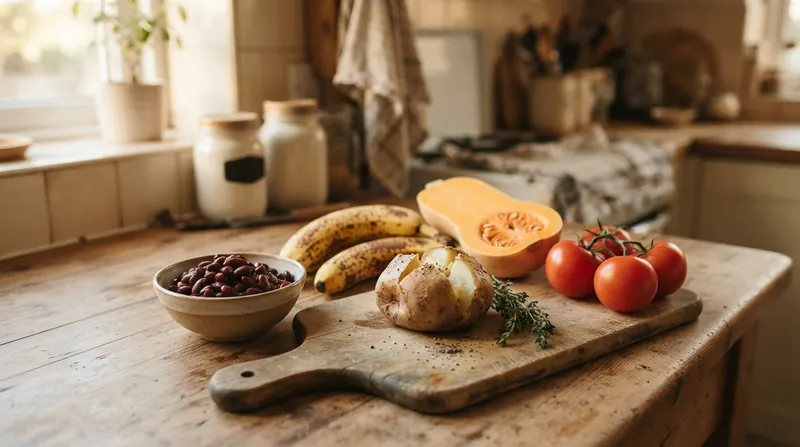
MedlinePlus, the consumer health encyclopedia of the National Institutes of Health, gives an adequate intake of potassium of 3,400 mg a day for men. [26]
Its list of sources reads like an ordinary grocery run: beans, lentils, tomatoes, potatoes with the skin, sweet potatoes, winter squash, citrus fruits, bananas, milk, yogurt, nuts and fish. [26]
It also advises talking with a provider before a potassium supplement, especially if you take anything daily. [26]
What should be in the glass besides the orange?
The guidelines say to choose water, still or sparkling, and unsweetened drinks, to avoid sugar-sweetened ones, and to drink less alcohol for better overall health. [27]
That rules out the energy drinks the grandkids leave in the refrigerator.
A 16-ounce energy drink can carry 70 to 240 mg of caffeine and 54 to 62 grams of added sugar. [28]
And if you smoke?
The CDC says quitting helps at any age, however long you've smoked, and that within a few days the carbon monoxide level in the blood drops to that of a nonsmoker. [29]
The American Heart Association scores eight things when it sums up the heart and circulation. [30]
Four are daily habits, like what you eat, how much you move and whether you smoke, and the other four are measurements best checked with a clinician. [30]
Not one of the eight comes in a bottle.
That's the most useful sentence on this page, and I didn't write it.
Who This Glass Suits, and Who Should Pass
I've read enough labels to know that no bottle is for everybody.
Here's how I'd sort it if you asked me across the fence.
It may suit you if:
- You want a daily source of CoQ10 and you like the idea of a liquid instead of a capsule.
- You eat a regular meal with some fat in it, most days, at about the same time.
- You don't mind measuring two level teaspoons and stirring them into a glass of water.
- You like a tangerine flavor and prefer no added sugar.
- You're comfortable with an honest "not tested on this bottle" and with trials that found higher blood levels, not more stamina.
- You've shown the label to your pharmacist, or you take nothing daily.
You may want to pass if:
- You're hoping to feel a difference on your walks, because the trials in men didn't find one.
- You take anything daily and haven't asked your pharmacist yet.
- You're allergic to sunflower seeds, or spicy ingredients bother your stomach.
- You usually skip meals or eat on the run, because the label wants a meal.
- You want a product that was itself tested in a study, because this one hasn't been.
If you're in the second group, that's a perfectly good place to be.
The walk and the plate don't need a bottle to work.
Fair Questions About Price, Taste and Time
Norm had three objections before he'd pour the first glass, and they're probably yours too.
So let's take them one at a time.
Isn't it expensive?
The listing showed $24.99 for the 8-ounce bottle when we read it on September 26, 2026.
At 24 servings, that's about $1.04 a day.
That's less than a cup of coffee at the diner on the corner.
Two things to know before you do the math on your own.
Shipping and tax aren't included in the price, and the listing mentions shipping at no charge only for subscription orders.
What does it taste like?
The label calls it tangerine, and it's sweetened with monk fruit extract rather than sugar.
Monk fruit comes from a plant of southern China, and its extract is many times sweeter than sugar, so a trace sweetens a whole bottle.
The panel lists no added sugar and 5 calories per serving.
The panel also says there's no yeast, milk, gluten, soy, gelatin, peanuts, shellfish, dairy, or artificial colors or flavors.
It's Non-GMO Project Verified, kosher parve and vegan, according to the maker.
Does it need the refrigerator?
Not unless the label says so, according to the maker's own questions page, which suggests keeping it at room temperature, about 68 to 77 degrees.
Norm keeps it in the cupboard beside the tumbler.
That way the bottle, the spoon and the glass are all in one place at six o'clock.
How long before I'd know anything?
Honestly, the calendar only tells you about the blood, not about you.
Blood levels take one to two weeks of daily use to reach a steady level. [11]
Beyond that, the trials don't give you a date to circle, because in healthy men they didn't find a change to wait for.
That's why I'd look at the return window next.
It's the one calendar the maker does print.
The Forty-Five-Day Promise, Read Out Loud
Nature's Answer offers what it calls a satisfaction promise, and the terms are worth reading the way we read the directions.
Here they are, in plain English.
- You have 45 days from the date of purchase.
- You return the unused portion of the bottle, and the maker will refund your money, send a replacement, or give you a credit for the unused part.
- You need proof of purchase and a return number from customer service before you send it.
- Return shipping is at your own cost.
- It covers end buyers in the United States, on the maker's website or at its authorized US sellers.
The main office is at 75 Commerce Drive in Hauppauge, and returns and legal notices go to 85 Commerce Drive on the same street.
Customer service answers at 1-800-439-2324, Monday to Friday, 8:30 to 5:30 Eastern.
Forty-five days covers almost two bottles at the label's amount.
If the glass doesn't fit your suppers, you'll know well inside that window.
Why There Are No Reviews on This Page
You may have noticed there are no customer quotes on this page.
That's not an oversight.
When we read the maker's page for this bottle on September 26, 2026, its review section showed no reviews at all.
Not a good one, not a bad one, not one.
We could have borrowed praise from some other CoQ10, or dressed up a neighbor's opinion as a review.
We didn't, and we won't.
So you'll have to make up your own mind from the label, the research and your own suppers.
I think that's the better way to decide anyway.
The Directions Again, on One Index Card
If I had to leave one card on Norm's porch railing, this is what I'd write on it.
- Two level measuring teaspoons, 10 mL, 100 mg of CoQ10; not the spoon from the drawer.
- Stirred into 8 to 10 ounces of water, the glass the label asks for.
- With a meal that has some fat in it, because CoQ10 is best absorbed that way. [8]
- Once a day; blood levels build over one to two weeks and peak about six hours after each glass. [11]
- Twenty-four servings to the bottle, about $1.04 a day at list price, shipping extra.
- Tested ingredient, untested bottle: the trials in men raised blood CoQ10, not stamina. [13]
- If you take anything daily, show the label to your pharmacist first. [16]
- Forty-five days to return the unused portion, return shipping on you.
Two teaspoons at supper, twenty-four suppers to the amber bottle
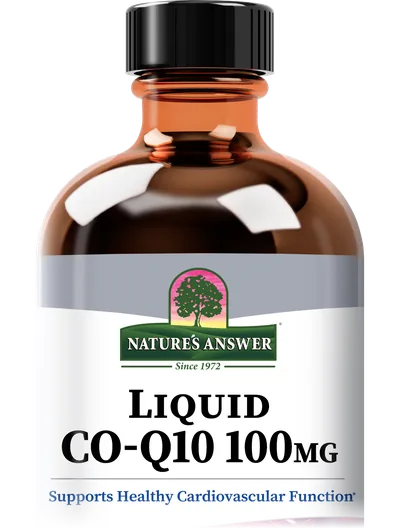
Two teaspoons of tangerine-flavored liquid stirred into a glass of water with a meal: 100 mg of CoQ10 in an amber glass bottle from a Long Island family company that has made liquid supplements since 1972.
CHECK AVAILABILITYSold and shipped by Nature's Answer, Inc., Hauppauge, New York · 8 fl oz amber glass bottle, 24 servings of 100 mg CoQ10 · returnable within 45 days of purchase under the maker's satisfaction promise; return shipping is paid by the buyer
Six O'Clock, and the Street Lights Come On
The other night, Norm and I sat on his porch after the second walk.
The kitchen lights were going off down the street, one after another, the way they come on at six.

He asked me what I'd tell a stranger who asked about the bottle.
I told him I'd tell them what I told him: read the line, use the right spoon, drink it with supper, and don't expect the bicycle to know.
He laughed and said that wasn't much of a sales pitch.
I said it wasn't supposed to be, but it was true, and true lasts longer on this street.
If you decide to try it, you now know how to take it the way it was designed to be taken.
And if you decide not to, you still have two walks and a supper at six, which is more than most bottles can offer.

Questions from across the fence
What is this, exactly?
A dietary supplement: liquid CoQ10, 100 mg per two teaspoons, tangerine-flavored, in an 8-ounce amber glass bottle. It isn't meant for any health problem.
How do I take it?
Two level measuring teaspoons (10 mL) in 8 to 10 ounces of water, once a day, preferably with a meal.
Why with a meal?
CoQ10 dissolves in fat, and it's best absorbed with the fat in a meal. [8]
Can I use a regular spoon from the drawer?
Use a measuring teaspoon. Silverware teaspoons vary in size, and the label's amount is 10 mL.
How long does one bottle last?
Twenty-four days at the label's amount.
Does it contain alcohol or sugar?
No alcohol, and no added sugar; it's sweetened with monk fruit extract.
Do I need to refrigerate it?
Not unless the label says so; the maker suggests room temperature.
Has this bottle been tested in a study?
No. The studies on this page tested CoQ10 itself, or other companies' products.
Will I walk farther?
The trials in men, including men aged 60 to 74, found higher CoQ10 in the blood but not more stamina. [13] [15]
Is it ubiquinone or ubiquinol?
Ubiquinone. Most CoQ10 in the blood ends up as ubiquinol either way. [9]
Should I talk to anyone first?
Your pharmacist, if you take anything daily. [16]
What if I don't like it?
Return the unused portion within 45 days of purchase for a refund, replacement or credit; you pay return shipping.
Sold by Nature's Answer, Inc., Hauppauge, New York. The price and any promotion are set by the maker.
Every line of the panel, from the CoQ10 and the sunflower lecithin to the three plants of the Quik-Sorb blend, is written out in the ingredient and advertising guide linked at the foot of this page.
The guide also explains what each of those ingredients is, which ones carry an amount and which don't, and the one question worth asking your pharmacist.